

An Emerging Green & Gold Hub in the Eternal City
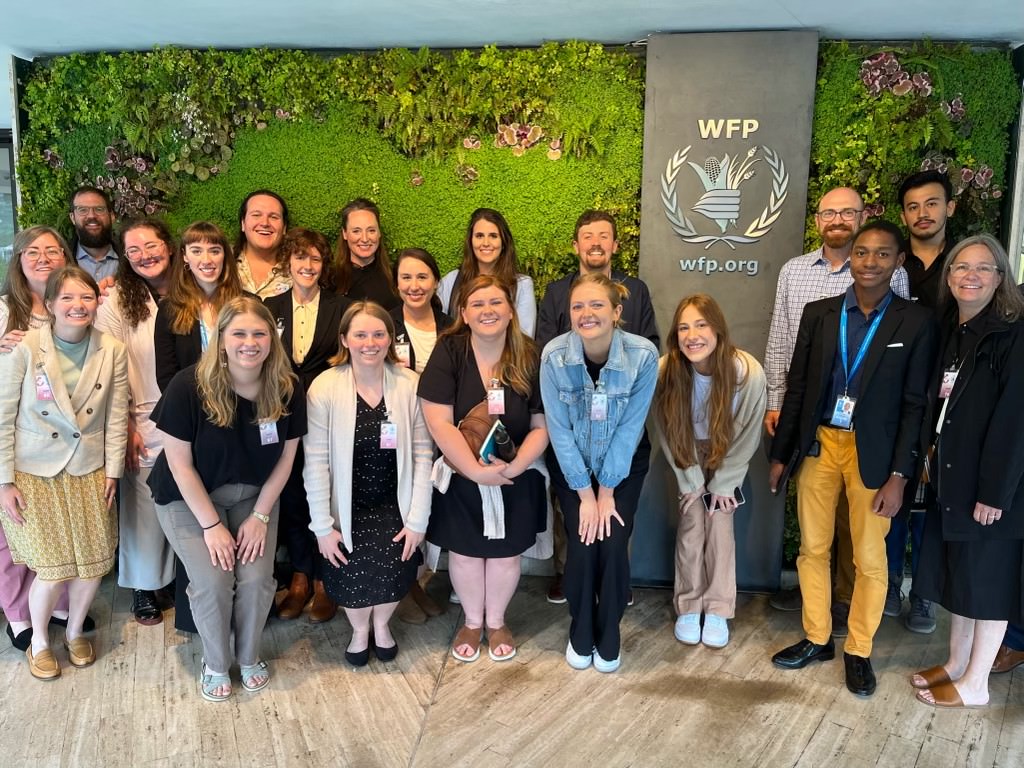
In June 2026, Dr. Jenny Howell, Director of the Theology, Ecology, and Food Justice Program, and Dr. Dennis Tucker led seventeen students through Rome, Florence, and Assisi for a course examining historical and contemporary models of food justice.
As we continue to advance the strategies outlined in Baylor in Deeds, Rome is emerging as one of Baylor’s first Global Hubs: a place where Baylor’s sustained presence, partnerships, and academic strengths can come together to create lasting impact for students, faculty, staff, alumni, and communities within the region.
What Is a Baylor Global Hub?
Hubs are designed to serve as a singular place for meaningful, multi-point engagement with the local community, allowing for participation from interdisciplinary and distinct units across the Baylor campus. The aims of Baylor Global Hubs are to facilitate the following endeavors in one place:
Faculty research and scholarship
Study abroad
Engaged learning opportunities
Conferences and educational forums
Service and Mission initiatives
Strategic partnerships with academic, civic, and community organizations
By leveraging the same place for these myriad activities, we aim to achieve the necessary economies of scale to provide accessible, low-cost, experiences for a diverse array of students, faculty, and staff.
Why Rome?
Over the past several years, Baylor faculty, students, and staff have intentionally invested in Rome and the surrounding region through sustained academic programming, research collaborations, service initiatives, and community engagement. What is emerging is not a new venture, but rather the recognition and coordination of work already taking place.
- Dr. Scott Moore, Associate Dean for Strategic Initiatives in the Honors College, has consistently led cohorts of students through Italy since 2021, introducing them to Dante, the Classics, and the intellectual traditions that shaped Western civilization. Through study experiences in Florence, Rome, and beyond, students engage with historical texts in the very places where those ideas took root.
- In May 2026, Dr. Rebecca Flavin, Director of Engaged Learning Curriculum, and Dr. Annie Ginty, Professor of Psychology and Neuroscience, led fourteen students on a study and service experience that combined academic learning with meaningful community engagement.
- That same month, Dr. Dennis Tucker, Professor of Christian Scriptures, and Dr. Elisabeth Kincaid, Director of the Institute for Faith and Learning, guided students and participants on a pilgrimage through significant sites, exploring the spiritual integration of place and practice. Their program demonstrated how physical locations can deepen reflection on faith, vocation, and discipleship.
- In June 2026, Dr. Jenny Howell, Director of the Theology, Ecology, and Food Justice Program, and Dr. Dennis Tucker led seventeen students through Rome, Florence, and Assisi for a course examining historical and contemporary models of food justice. The program reflects Baylor’s commitment to addressing global challenges through interdisciplinary scholarship and practical engagement. Dr. Howell’s success in securing external funding for the course for the next seven years underscores both the program’s significance and its sustainability.
Discovery Beneath the Surface
Perhaps nowhere is Baylor’s growing presence more evident than in the archaeological work taking place just outside Rome, in the city of Barbarano Romano, as part of the San Giuliano Archaeological Research Project.
Since 2016, Dr. Davide Zori, Professor of History and Archaeology, and Dr. Colleen Zori, Senior Lecturer in Archaeology, working alongside local civic leaders, scholars, Baylor students, and faculty collaborators, have uncovered two previously unknown Etruscan tombs. The discoveries represent not only significant scholarly achievements but also a powerful example of Baylor’s distinctive approach to international engagement, which includes research conducted in partnership with local communities while simultaneously providing transformative learning opportunities for students. Over the years, more than 150 undergraduate students , a dozen graduate students , and several faculty members have participated from the following disciplines at Baylor: Baylor Interdisciplinary Core, Classics, Anthropology, Art History, Religion, Geosciences, and Museum Studies (Mayborn Museum). Additionally, this work has yielded more than 10 articles, several of which include students as contributing authors.
This program illustrates what a Baylor Global Hub can accomplish at its best. Scholarship, teaching, community partnership, and student formation are not separate activities. They reinforce one another in ways that advance both academic excellence and meaningful service.
What’s to Come?
Several opportunities are already taking shape for future efforts in Rome, including:
Continued expansion of study abroad programming throughout the region
A potential Baylor Semester in Rome
Alumni engagement initiatives, including a planned Truett Seminary alumni experience
Internship placements with influential international organizations such as the Food and Agriculture Organization of the United Nations (FAO)
New partnerships in areas such as sustainability, integral ecology, faith, culture, and public service
These efforts demonstrate how a Baylor Global Hub can serve multiple constituencies while advancing Baylor’s strategic vision for global engagement.